
Determination of chemical and mechanical properties using Raman and Brillouin spectroscopy
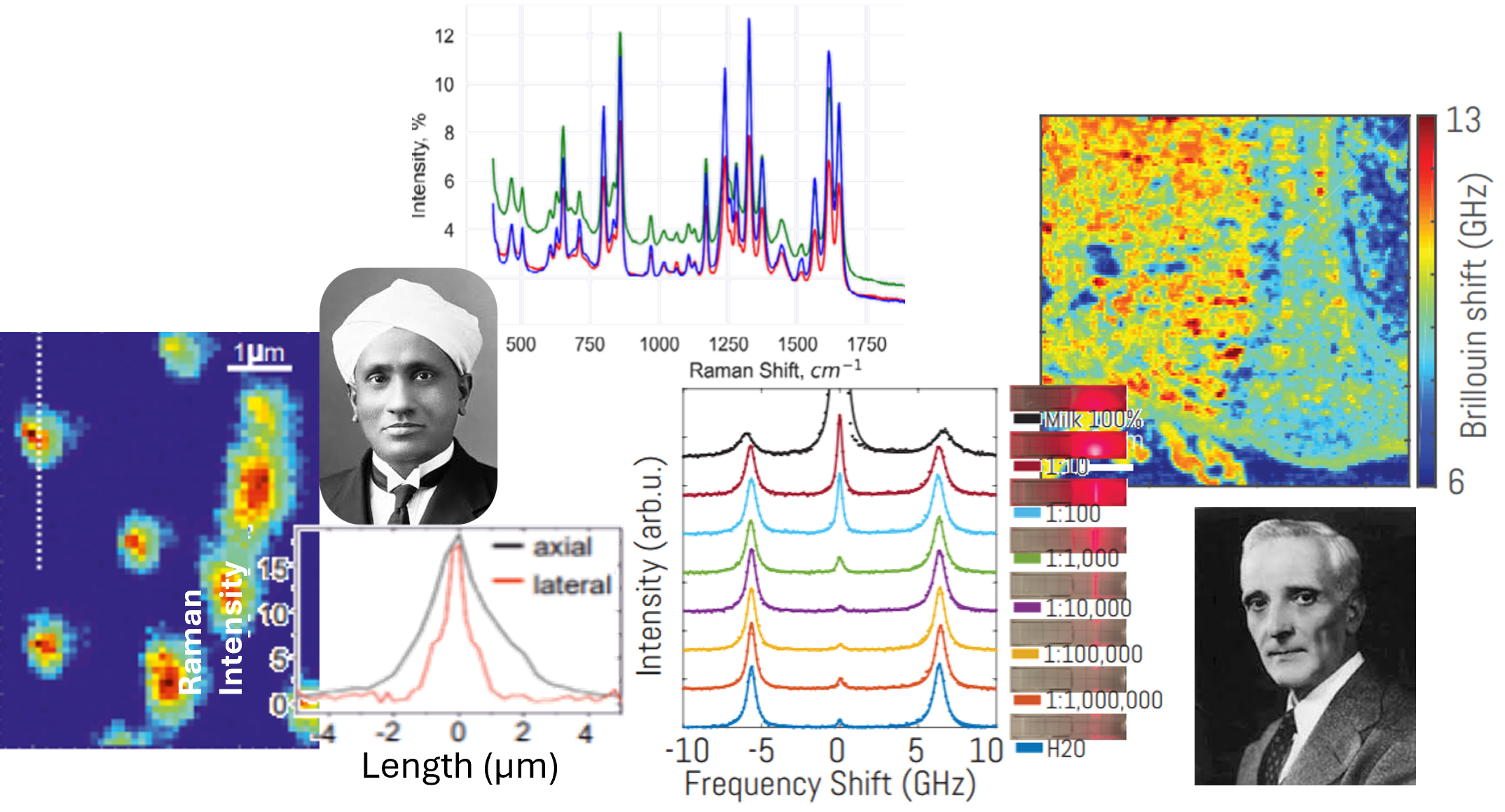
If you want to determine the chemical and mechanical properties of a sample, a combination of Raman and Brillouin spectroscopy is ideal. Both techniques use the interaction of light with matter to obtain chemical and mechanical information about a sample.
In Raman spectroscopy, optical phonons provide information about chemical properties, whereas in Brillouin spectroscopy, acoustic phonons indicate (bio)mechanical properties.
Raman
- …is based on inelastic scattering, the Stokes (or anti-Stokes) oscillation, which is much weaker than that of Rayleigh scattering.
- …uses monochromatic light, the sample is excited, the scattered light is Raman scattering
- …active vibrations are obtained when the polarization of the molecules changes.
- …spectroscopy is usually non-destructive, label-free, and versatile, requiring little sample preparation.
- …spectroscopy is used for quantitative and qualitative analysis of samples.
- …shift lies in the wave number range corresponding to molecular vibrational energies, the so-called “fingerprint region.”
- …spectroscopy can be combined with optical microscopy.
- …measurements are performed in the visible wavelength range; no expensive optical components are required.
Brillouin
- …is based on inelastic scattering of light by acoustic phonons; vibrations are also referred to as Stokes and anti-Stokes
- …preserves the mechanical properties of the sample
- …is a label-free, non-contact technique that allows subcellular spatial resolution and 3D volume imaging to be obtained.
- …scattering is very weak, so Rayleigh scattering must be suppressed.
- …shift is in the GHz range, i.e., a sensitive detector and a narrow-band laser are required.
Advantages of using both techniques:
- The measurement remains non-destructive
- No photon is lost, meaning that both spectroscopy techniques can be performed with a single light source.
- Use of the same measurement setup (same laser or microscope) with two different detectors
- Simultaneous acquisition of chemical (Raman) and mechanical (Brillouin) information from a sample
- Raman + Brillouin + microscopy = chemical + mechanical + visual properties