
Paper Spotlight: Specto Photonics
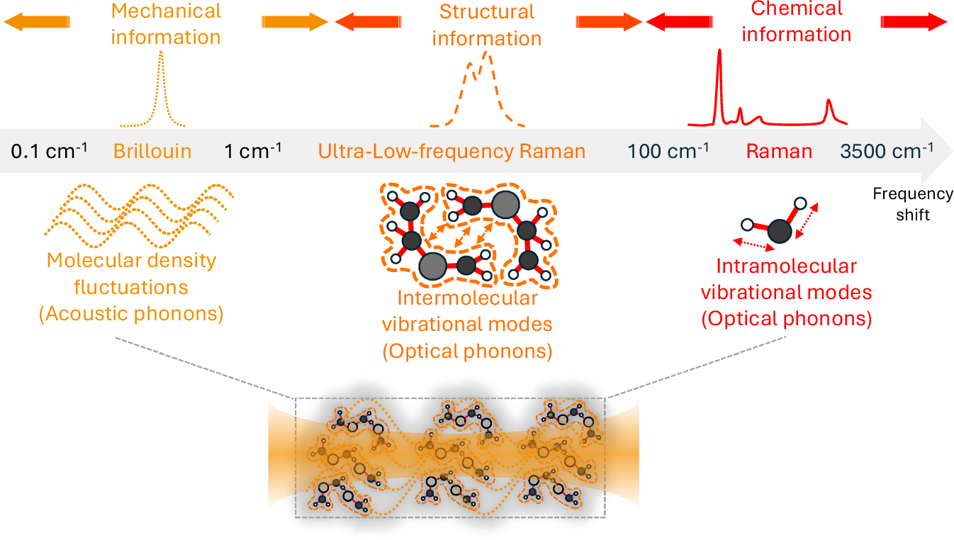
Characterizing active pharmaceutical ingredients requires the simultaneous measurement of chemical, structural, and mechanical properties. Today, we would like to introduce a new spectroscopic method that allows these three properties to be determined in parallel.
A new paper from specto Photonics presents a method for measuring the vibrational spectrum from 0.1 to 3,500 cm⁻¹.
This field includes Brillouin, terahertz (THz, also known as ULFR [Ultra Low Frequency Raman]), and conventional Raman spectroscopy.
The three spectral ranges provide different types of information:
- Brillouin spectroscopy: Information on mechanical properties; acoustic phonon vibrations.
- THz Raman (here: 10–200 cm⁻¹): Information on the structural arrangement and phase of the materials under investigation; intermolecular vibrations.
- Conventional Raman spectroscopy (here: 200–3,500 cm⁻¹): Information about the chemical composition and molecular structure; intramolecular vibrations
The focus of this paper is the BIPD filter. It suppresses elastic scattering—such as Rayleigh and Mie scattering—as well as unintended reflections even before the parallel measurement of Brillouin and Raman spectra. This is achieved using a phase delay induced by birefringence, which features a high extinction ratio and a narrow bandwidth.
Why is such a parallel measurement necessary?
The identification of amorphous phases plays a particularly important role in the study of active pharmaceutical ingredients, or APIs. However, these are difficult to characterize using conventional spectroscopic methods because they lack a well-defined structure. At the same time, amorphous structures influence key properties such as stability, manufacturability, solubility, and bioavailability—as well as the therapeutic efficacy—of drugs, such as ibuprofen or acetaminophen.
The key advantage of combined measurement is that chemical, structural, and mechanical information can be acquired simultaneously at the same measurement point. This allows for a much more comprehensive characterization of various material states and, in particular, enables a more reliable distinction between amorphous and crystalline phases than is possible with individual spectroscopic methods.
The combination of THz and conventional Raman and Brillouin spectroscopy creates a platform for the characterization and classification of solid-state active pharmaceutical ingredients. While Raman spectroscopy provides chemical and structural information, Brillouin spectroscopy additionally enables the differentiation of various structural forms based on their viscoelastic properties. The combination of all three spectral ranges increases the sensitivity and selectivity of active ingredient characterization and offers potential for applications in pharmaceutical development, process monitoring, and quality control. Furthermore, the method opens up new possibilities in the life and material sciences. In combination with confocal microscopy, this approach forms the basis for fully optical, label-free, and multimodal imaging that delivers three-dimensional mechanical, structural, and chemical maps with submicrometer resolution.