
Isolators from MinusK Technologies in quantum optics or quantum computers
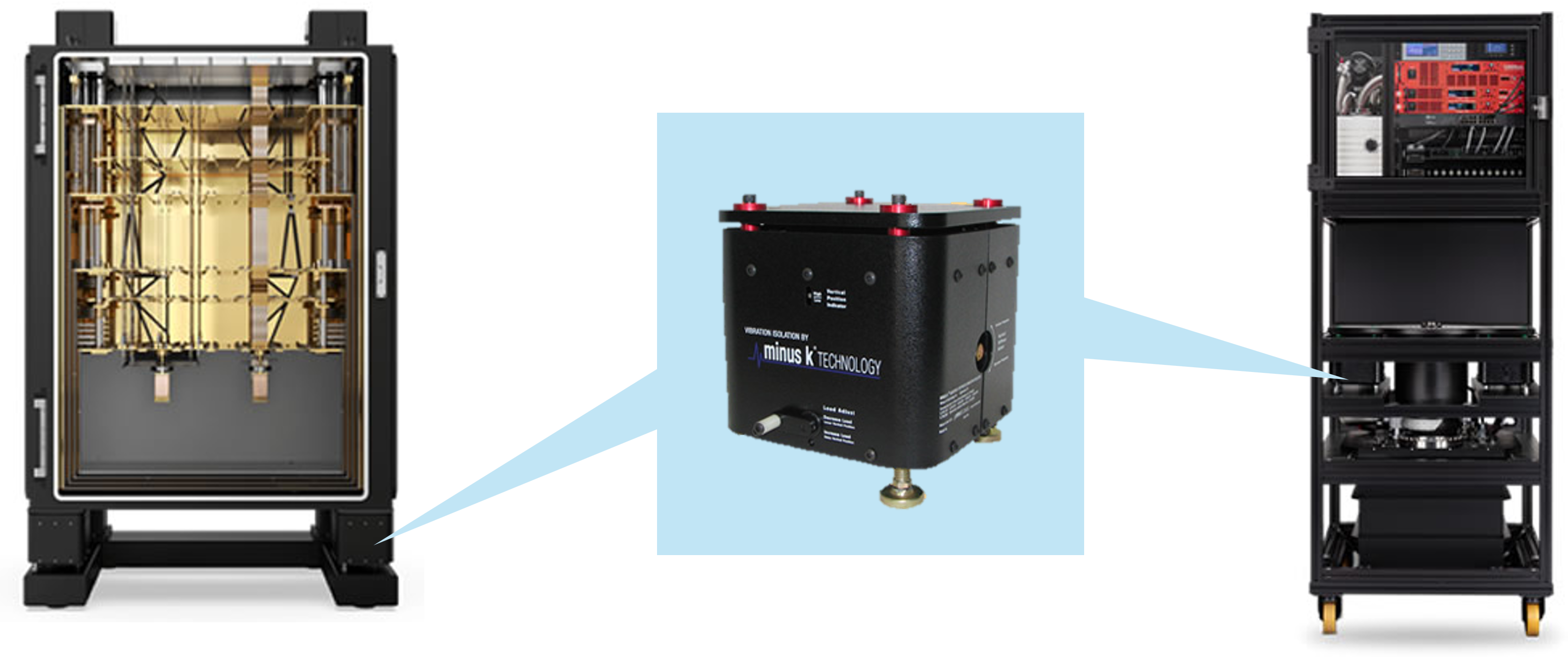
In quantum computers, individual atoms are trapped using laser traps and cooled to temperatures near absolute zero. The excitation of these atoms (which function as qubits) and the reading out of information are also performed using lasers. The stability requirements for these lasers are incredibly high.
This precise methodology requires that vibrations in the laboratory or the surrounding environment have no effect. Therefore, the experiments are shielded from vibrations as effectively as possible by vibration-isolating platforms—also known as isolators.
CM-1 Low Frequency Vibration Isolator from MinusK Technologies
The image above shows two cryostats from Maybell Quantum and Kiutra*, in which 2 and 4 CM-1 Low Frequency Vibration Isolators from MinusK, respectively, have been installed. Temperatures inside the cryostats are in the sub-Kelvin range, making them a suitable environment for superconductors—or, more specifically, quantum computers.
The CM-1 is a compact isolator (20 cm x 20 cm x 21.6 cm) with a high maximum payload of 473 kg.
It is often used as a vibration-isolating base for larger setups such as electron microscopes, optical stages, or cryogenic chambers for quantum experiments.
Another common application involves setups in racks, such as laser systems or measurement setups.
This requires an isolator with a particularly compact height, which is why the CT-2 and CT-10 were designed (height 6.86 cm) and offer two possible sizes in X (45.7 cm x 50.8 cm) and Y (32 cm x 32 cm).
The advantages of MinusK Technologies’ vibration-isolating platforms are their stable and versatile design, but above all, their mode of operation.
The “negative stiffness,” which is generated solely by internal springs, requires neither electricity nor compressed air. Once the load is centered on the isolator and the spring stiffness is adjusted to the weight, the top plate enters a state of suspension and oscillates at a natural frequency of 0.5 Hz (during deflection); all other frequencies are suppressed by several orders of magnitude. This works automatically without any further intervention, without running costs or power consumption.
*Quelle: https://www.minusk.com