
mesoSPIM: Three-Dimensional Microscopy using Oxxius laser combiners
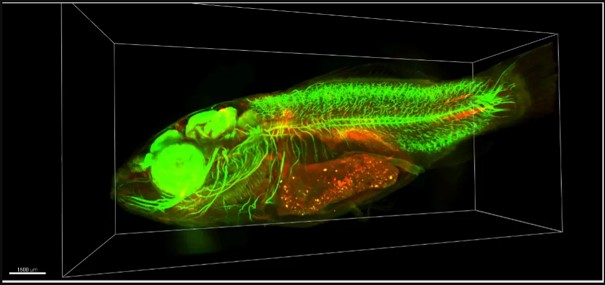
In a collaboration involving several research groups from the IERP at the French National Institute for Agricultural, Food, and Environmental Research (INRAE) as well as groups from LuMin (ENS Paris-Saclay), a mesoSPIM system was used to generate three-dimensional images of organs and even entire organisms.
Fluorescence excitation was achieved using Oxxius lasers, which are combined in a Mixxwave Combiner and controlled centrally.
mesoSPIM (mesoscale selective plane illumination microscopy) is a specialized form of light-sheet microscopy. In this technique, individual layers of tissue, organs, or even small animals—which have been made transparent—are illuminated from both sides with laser light, while a detector positioned at a right angle and synchronized with the light source detects the excited fluorescence. The acquired layers are then reconstructed into a three-dimensional image.
This method allows for the combination of a large field of view (FOV) with high spatial resolution—two characteristics that are typically difficult to reconcile.
Another distinctive feature of mesoSPIM technology is that it is being developed as an open-source project. The mesoSPIM Initiative was launched by Nikita Vladimirov’s research group at the University of Zurich and is based on their development of a compact benchtop system (N. Vladimirov et al., Nature Commun. 2024, 15, 2679). Since then, the platform has been continuously refined and expanded in collaboration with more than 35 research groups worldwide.
As with any form of fluorescence microscopy, the excitation lasers play a central role. For mesoSPIM applications, a Mixxwave Combiner from Oxxius is therefore often recommended; it is also used in the projects mentioned above.
Laser combiners offer several key advantages:
- Stable output power: Since changes in fluorescence intensity in each layer should be caused solely by the sample and not by fluctuations in the excitation laser, a laser system with exceptionally low noise is essential.
- Flexible power adjustment and modulation: The laser power can be precisely adjusted to suit different samples. In addition, both diode and DPSS lasers support modulation frequencies up to the MHz range.
- Easy integration: The combiner is compact, mechanically robust, and portable. It can also be controlled via various interfaces and easily integrated into existing software environments.
- Flexible beam routing: The laser beams can be split between one or two outputs. Using the MDL-FSTM module, an integrated mirror allows switching between the outputs in less than 30 ms. This feature is essential for certain mesoSPIM measurement methods.
The laser combiners can be customized to meet the specific requirements of your experiment. Thanks to ongoing advancements in laser technology, both the available wavelengths and the achievable output powers are constantly expanding.
If you’d like to join the mesoSPIM community and are looking for a suitable laser solution, we’d be happy to advise you on selecting the optimal system.
P.S.: We’re also happy to assist you with other components of your mesoSPIM setup. These include, for example, high-precision micropositioners and vibration-isolating platforms with a 25-mm grid, which can be seamlessly integrated into such systems.
Learn more about OXXIUS laser combiners